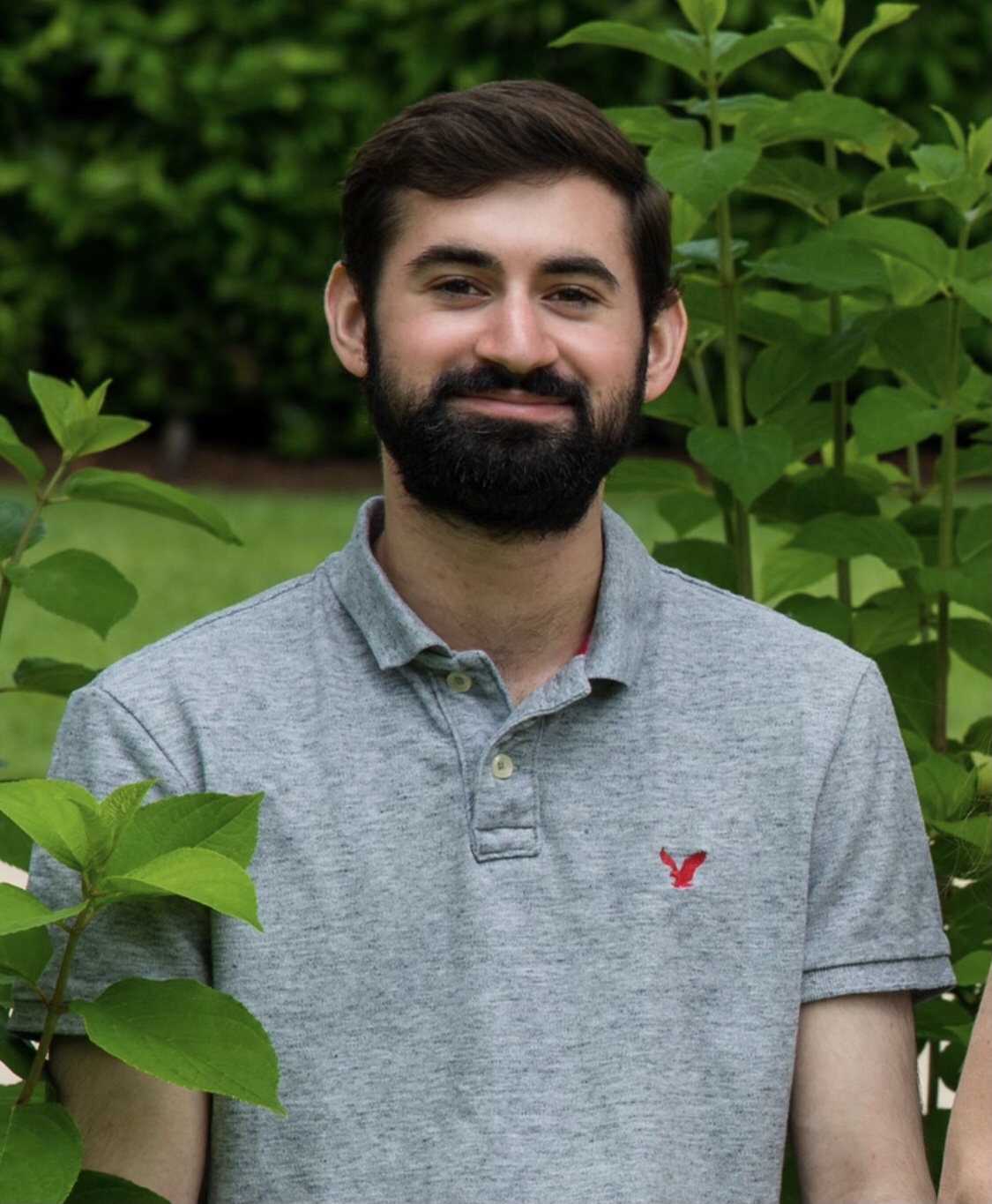
A photo of Ryan Golant

Hi! I'm Ryan Golant.

I'm a sixth-year Ph.D. candidate and a NASA FINESST Future Investigator in the Columbia University Department of Astronomy & Astrophysics. My research broadly addresses the interplay between magnetic fields and turbulence in hot and diffuse (collisionless) astrophysical plasmas. I'm particularly interested in the question of cosmic magnetogenesis, or how the first magnetic fields in our Universe came into being; my thesis work — advised by Professors Greg Bryan and Lorenzo Sironi — looks at how magnetic fields may arise from turbulence and how this could explain the presence of magnetic fields in the vast empty regions of the Universe called cosmic voids. To tackle this puzzle, I have gained expertise in both plasma physics and cosmology, employing both small-scale kinetic plasma simulations and large-scale cosmological simulations (and developing software for the latter). You can read more about my research here.

I'm also very interested in teaching, science communication, and public outreach. I have dedicated much of my grad school career thus far to pedagogical development, science writing, and community service leveraging my scientific expertise: I have designed, from scratch, my own course on astrophysical magnetic fields (and I will be teaching this course in Spring 2026), I have co-led a published education research study, I have organized pedagogy workshops and seminars for my department and for the university, I have written numerous articles on astronomy research for a broad audience, and I have led my department's public outreach program. You can read more about my teaching, writing, and outreach down below.

Beyond academics, I enjoy playing violin and video games, learning new things (my interests range from art history to mythology and folklore to jazz and music theory), and playing with my cat, Alfvie. If you have any cute cat photos or videos of your own, feel free to send them my way!.
Research

Here's a sample of some of the research I'm working on:

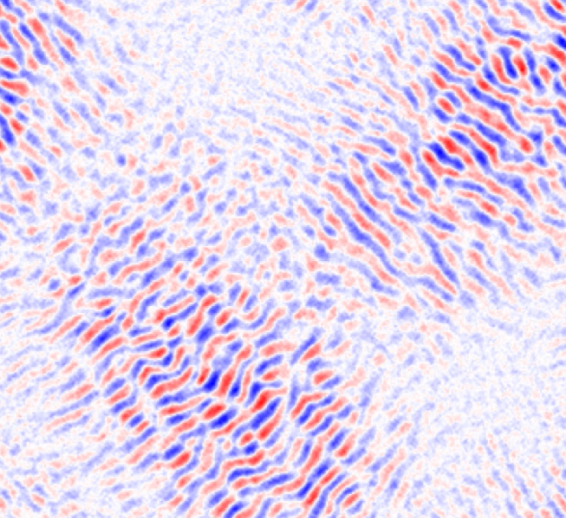
filamentary magnetic fields generated by randomly stirring a collisionless plasma

Turbulent Magnetogenesis & The Collisionless Dynamo

Magnetic fields are everywhere throughout the Universe — and we don't know why. Interestingly, however, something as simple as turbulence (or random stirring of a collisionless plasma) can not only generate magnetic fields from scratch, but can subsequently amplify these fields to large scales and to dynamically important strengths. This process, known as the collisionless small-scale dynamo, could be the source of galactic and extragalactic magnetic fields; understanding the history of these fields is essential for building accurate models of, for example, galaxy evolution and the development of the Universe's large-scale structure. Read more about the collisionless dynamo process in this paper (with Lorenzo Sironi and Luca Comisso). I'm currently pushing our simulations of turbulent magnetic field creation and the collisionless dynamo into more realistic parameter regimes — stay tuned for a paper on turbulent magnetogenesis in collisionless electron-ion plasmas soon.

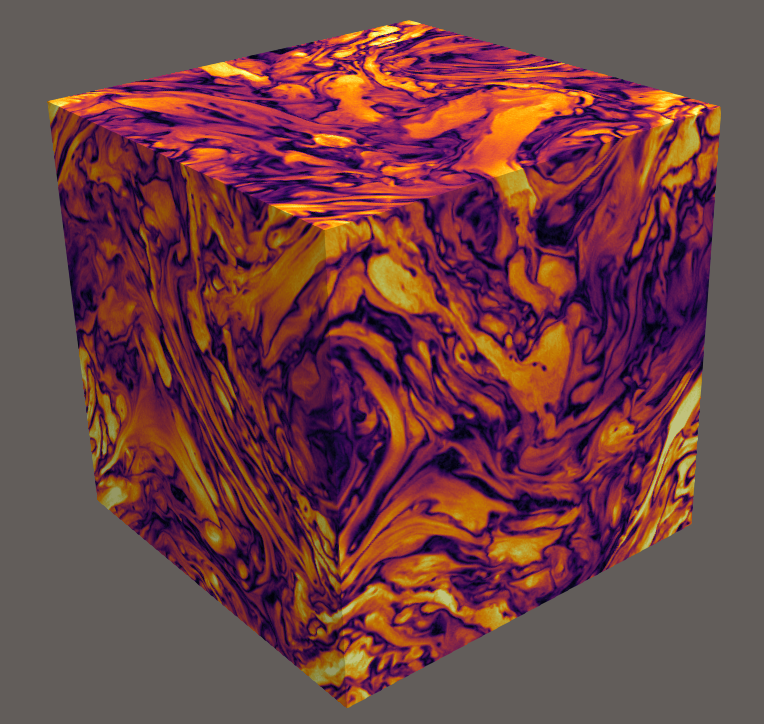
collisionless large-amplitude turbulence resulting from one of our small-scale dynamo simulations

Intermittency in Collisionless Large-Amplitude Turbulence

The saturated steady state of the collisionless small-scale dynamo is a fluid-like regime known as collisionless large-amplitude turbulence. In a recent paper (with Luca Comisso, Philipp Kempski, and Lorenzo Sironi), I showed that this turbulence is filled with intense, localized, so-called intermittent structures like sharply bent magnetic field lines and microscopic fluctuations in the magnetic field known as micromirrors and firehoses. This collisionless turbulence resembles its fluid counterpart in a broad sense but differs in crucial ways due to the development of pressure anisotropy with respect to the magnetic field. Since the intermittent structures in large-amplitude turbulence are efficient scatterers of charged particles, my work has important implications for the propagation and acceleration of cosmic rays in the interstellar medium of galaxies and the intracluster medium of galaxy clusters, where collisionless large-amplitude turbulence is likely widespread. In future work, I plan to trace particle trajectories through simulated collisionless large-amplitude turbulence to precisely probe how particles move and accelerate throughout such environments.

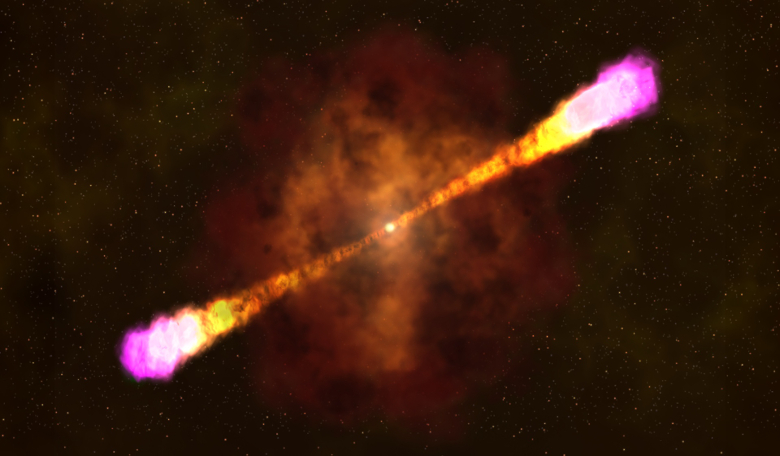
a GRB and its afterglow

Large-Scale Magnetic Fields in GRB Afterglows

We know that the "afterglow" light left behind by gamma-ray bursts (or GRBs, a class of violent astrophysical explosions) is due to charged particles spiraling around in magnetic fields. Curiously, however, observations of GRB afterglows suggest that these magnetic fields have spatial scales much larger than any of our current theoretical models predict. So, where do these large-scale magnetic fields come from? Our simulations demonstrate that a significant amount of field amplification occurs ahead of the GRB's external shock wave as a result of kinetic plasma instabilities; the field generated by these instabilities could be a key contributor to the field powering the afterglow. For more info, check out this paper (with Arno Vanthieghem, Daniel Groselj, and Lorenzo Sironi).

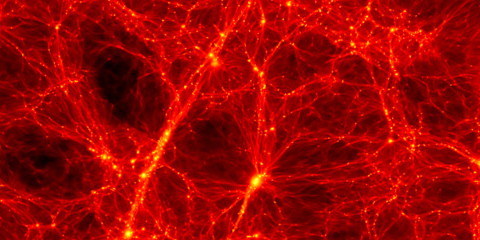
a cosmic web simulated by Enzo

Turbulence and Magnetic Fields in Cosmic Voids

Even in the most underdense regions of the cosmos — cosmic voids, where densities can sink down to one proton per cubic meter — we find magnetic fields. How (and when) did voids fill up with magnetic fields? Were these fields generated early in the Universe (soon after the Big Bang), or were they generated by more recent astrophysical phenomena? By studying how turbulence behaves in cosmic voids via large-scale cosmological simulations — and by comparing these measurements with our small-scale simulations of the collisionless dynamo — we may be able to solve this magnetic mystery. Stay tuned for more on this soon (with Greg Bryan).

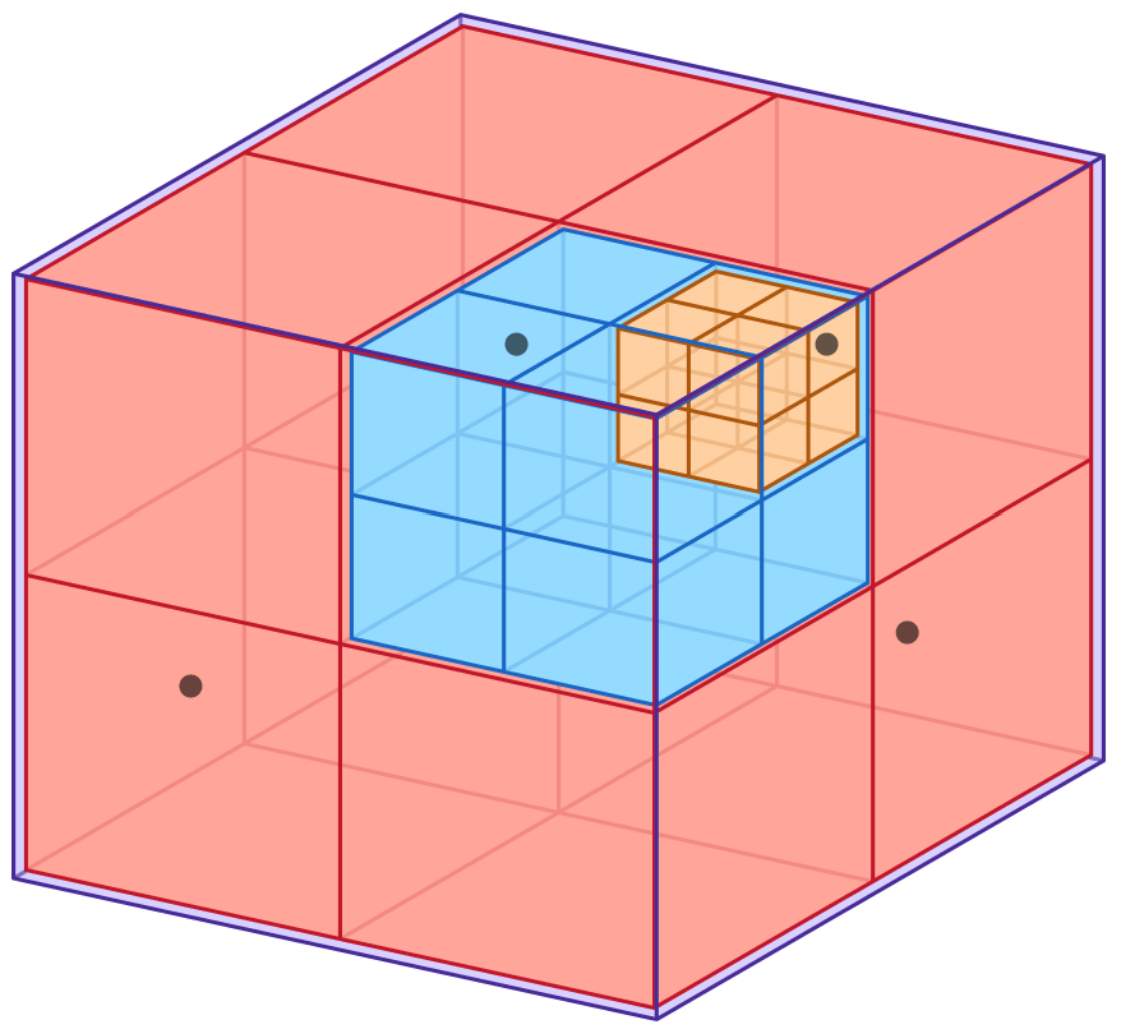
partitioning of an Enzo-E simulation box into octants, as required for the Fast Multipole Method

Gravity in Enzo-E

With the number of computational cores in supercomputers increasing exponentially each year, it is vital that we design software that can keep pace with these rapid improvements. Enzo-E — a state-of-the-art cosmological hydrodynamics code — is designed to deliver the scalability required to bring computational astrophysics into the exascale era. I've been leading the development of Enzo-E’s new gravity solver, a novel implementation of the Fast Multipole Method (FMM), a tree-based algorithm that should scale nearly linearly with the number of particles in a simulation. When coupled with efficient adaptive mesh refinement and asynchronous parallelization, we expect this implementation of FMM to speed up Enzo-E substantially, allowing for unprecedented detail in future cosmology and astrophysics simulations. Stay tuned for more details on Enzo-E's performance once the new gravity solver is fully optimized (with the help of Greg Bryan, Matthew Abruzzo, and James Bordner).

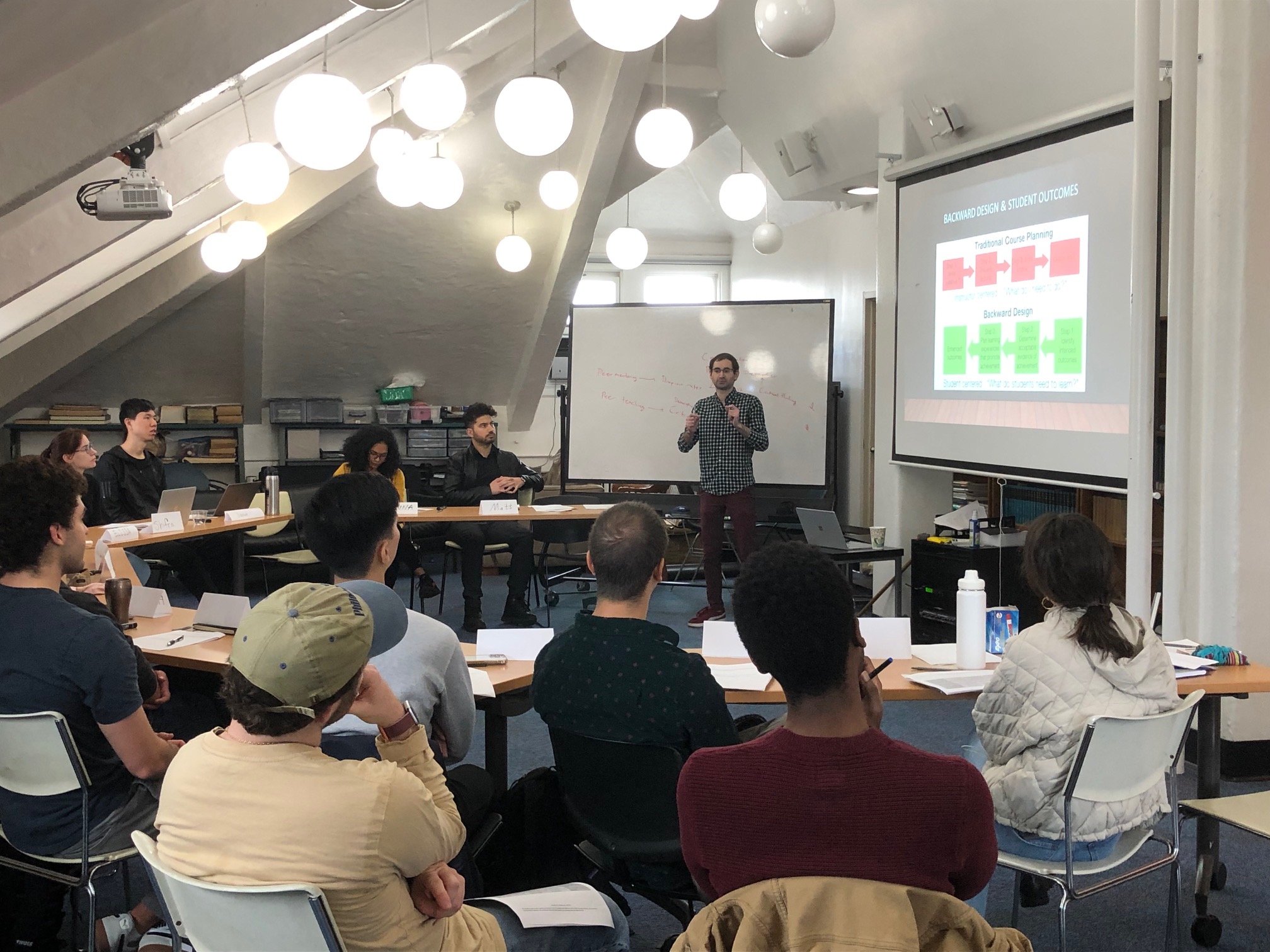
A photo of Ryan leading a pedagogy workshop

Teaching

I believe that no one is a "natural teacher;" being an effective educator requires practice, observation, and ongoing critical self-reflection. As such, I've tried to take advantage of Columbia's pedagogical development resources to improve my teaching practice. For the past few years, I have participated in the Columbia Center for Teaching and Learning's Teaching Development Program (CTL TDP), participating in workshops, learning communities, and other teaching exercises. I've also taken advantage of the resources offered by the Center for the Integration of Research, Teaching, and Learning (CIRTL) to learn the best practices for STEM teaching. In Fall 2022, I completed the online CIRTL course "An Introduction to Evidence-Based Undergraduate STEM Teaching," and in Spring 2023 I completed the course "Advancing Learning Through Evidence-Based STEM Teaching."

For the 2022-2023 academic year, I served as a Lead Teaching Fellow (LTF) for the CTL. In this role, I served as a liaison between the CTL and the Columbia astronomy department, organizing pedagogical development events in the department and advertising the CTL's teaching resources to the astronomy grad students. In October 2022, I held a workshop titled "Teaching Scientifically: Improving your teaching via the scientific method," in which I introduced the concept of "Teaching-as-Research" and led participants through the basic steps of planning a Teaching-as-Research project; in March 2023, I held a similar workshop titled "Inquiry-based learning: Teaching students to think like scientists", during which we discussed best practices for implementing inquiry-based learning in astronomy, with particular focus on inquiry-based labs. The following academic year (2023-2024), I served as a Senior Lead Teaching Fellow (SLTF), mentoring a cohort of LTFs and co-developing the workshop "Moving Forward Together: The Interdependence of Instructor and Student Motivation," which was run both in-person via the Columbia CTL and online via CIRTL.

In December 2022, I helped start a new teaching development initiative in the astronomy department called "Teaching Tea." The goal of Teaching Tea was to provide an open forum for teaching-related discussions in the department, bringing together astronomers at all career stages to share and reflect on their teaching experiences. In September 2023, we rebranded Teaching Tea to ``CommuniVerse,'' broadening the scope of our discussions to include science communication. Since then, CommuniVerse has been going strong with two meetings per month and regular attendance from grad students, postdocs, and faculty.

I was recently awarded the GSAS Teaching Scholars Fellowship, allowing me to teach a new class of my own construction during the Spring 2026 semester. You can find the syllabus for this new course -- titled "Our Magnetic Universe: An Introduction to Astrophysical Magnetism" -- here.

The Astrobites logo

Writing

I believe that the ability to convey complex scientific ideas in a way that's understandable and interesting to a non-specialist audience is a vital skill that, unfortunately, still remains undervalued by many scientists. Since 2021, as an author for Astrobites, I've been able to practice this skill, translating recent astronomy research into brief, undergrad-level written summaries. Check out some of my Astrobites articles below!

Recently, I've been getting acquainted with longer-form science writing, on the scale of feature articles for major popular science publications. As I continue writing about science, I'll be sure to post my articles here!

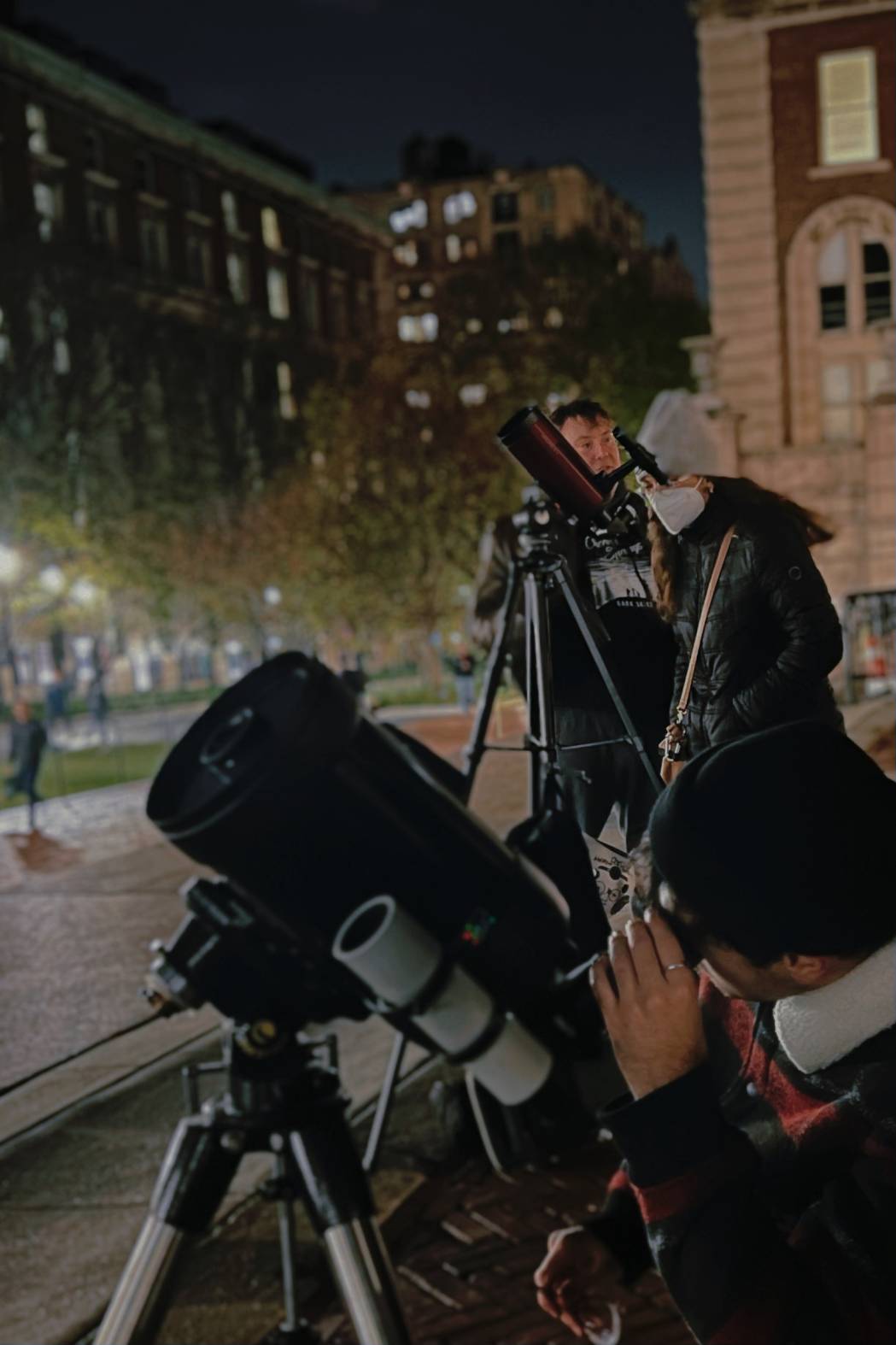
People looking through telescopes on Columbia's College Walk

Outreach

My favorite aspect of being an astronomer is the opportunity to share my enthusiasm for the cosmos with others. As a grad student, I've had the privilege to engage with the public on many occassions.

In October 2022, I took the lead in reviving the Columbia astronomy department's public outreach program, after the pandemic all but dismantled the department's in-person outreach opportunities. With the help of Professor Kathryn Johnston and a handful of undergrads, we successfully organized the first in-person, post-lockdown departmental outreach event, featuring a public talk by Professor David Kipping and a night of telescope observing in the center of Columbia's main campus.

Since then, I've spearheaded the growth and reorganization of our outreach program, helping start new astronomy programs for kids and coordinating regular public talks and public stargazing events. Check out everything that our outreach program is doing here, and sign up for our mailing list here! (see also this great article about us in Columbia Magazine)

During my time in New York, I've tried to seize every possible opportunity to use my science expertise for community service. For three semesters, I taught computer science and programming fundamentals to underrepresented students at Democracy Prep High School in Harlem as part of an after-school "Coding Club." I have also guest-taught multiple astronomy-related lessons to underrepresented youth in NYC, at both local community centers and elementary schools. Soon, I plan to implement a new astronomy outreach and education program for pediatric patients at Memorial Sloan-Kettering Cancer Center; as a former pediatric cancer patient myself, it's an honor to be able to give back to the pediatric oncology community in a meaningful way.

Send me a message!

(or contact me via email or Bluesky)


Find me on ...